
Quality Control for Custom Baseball Jerseys from Sample to Shipment
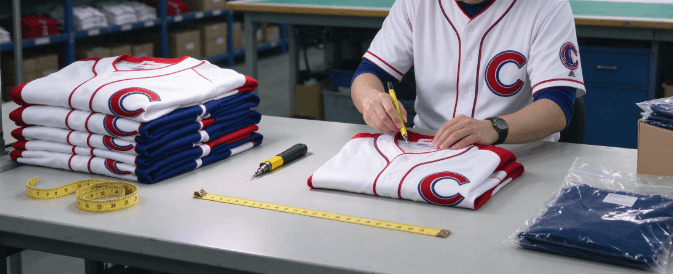
Quality control for custom baseball jerseys works best when each requirement is agreed before bulk cutting. A sample can confirm appearance and construction, but a repeatable order also needs a size chart, artwork control, material definition, inspection method, and packaging plan. Aihehua’s website describes a workflow that includes pattern and cutting, sewing, finishing and decoration, inspection, and packing. It also reports a 100-piece minimum, sample lead time of 10–15 days, and typical bulk production of about one month after sample approval. These are company-published planning figures; they should be confirmed for each order and should not be mistaken for test results or a defect-rate guarantee.
Lock the approved reference before production
Create one controlled tech pack for each style. It should contain the garment views, measurement points, tolerance table, fabric description, color references, stitch details, logo artwork, name and number rules, label copy, and packaging requirements. Assign a revision number and approval date. When an artwork file changes, update the revision rather than sending a replacement image without explanation. This prevents cutting and decoration teams from working from different versions.
The pre-production sample should represent the intended fabric, construction, trims, logo method, and labels. Review it in good light and compare it against the signed specification. Check front and back alignment, button spacing where applicable, collar shape, sleeve balance, seam appearance, and the feel of the garment. Record corrections on a sample review sheet and approve a final sample only after each open issue is closed.
Define fabric and color tests with criteria
The supplier’s product page does not establish one universal fiber composition, fabric weight, or test result for every custom jersey. Specify the material for the order and agree which tests matter. AATCC’s published methods include TM61 for accelerated colorfastness to laundering, TM8 for colorfastness to crocking, TM135 for dimensional changes of fabrics after home laundering, and TM15 for colorfastness to perspiration. Select methods according to the product claim and use conditions.
A test method is not an acceptance limit. The buyer and supplier need to agree the specimen, conditioning, procedure option, number of cycles where relevant, grading scale, and pass/fail threshold. For example, a colorfastness evaluation may focus on color change, staining, or both. Dimensional-change testing should define the laundering procedure and the maximum acceptable change. If a jersey includes contrasting panels, piping, or transfer numbers, test representative combinations because color migration or differential shrinkage can occur at interfaces.
Measure garments consistently
A garment inspection should use a defined method for each point of measure. Lay the jersey flat without stretching, align seams, and measure the same points shown on the chart. Record chest width, body length, sleeve length, and other agreed dimensions. Define whether a measurement is taken from seam to seam, edge to edge, or along a curve. Use the same approach for samples and production units so comparisons are meaningful.
Inspect sewing and decoration as separate features
Sewing checks should cover seam continuity, skipped or broken stitches, loose threads, puckering, seam alignment, and attachment of buttons or other trims. The inspection plan should define which defects are critical, major, or minor for the intended use. A loose closure may affect function, while a small isolated cosmetic irregularity may be treated differently under the agreed standard. Photos can make visual criteria clearer, but the standard should specify viewing distance and lighting where appearance is subjective.
Decoration requires its own inspection. Verify spelling and number accuracy against the player list, placement from defined garment landmarks, orientation, color, registration, and adhesion or stitch security. Check that names and numbers are legible and consistently placed across sizes. For heat transfers, follow the agreed durability test or care procedure. For embroidery, check thread coverage, backing, puckering, and reverse-side comfort if it contacts the wearer.
Use a practical inspection matrix
The matrix below connects a quality characteristic to a verification method. Its methods are examples, not a claim that Aihehua has completed these tests or that each product passes a particular score. The acceptance column must be completed by the buyer and supplier for the project.
Example custom jersey quality control matrix
Characteristic | Possible verification | Order-specific acceptance |
Colorfastness | AATCC TM61 laundering; TM8 crocking | Agree method option and grading threshold |
Dimensional change | AATCC TM135 fabric laundering test | Set procedure and acceptable change |
Garment measurements | Flat measurement against approved size chart | Define points, tolerance, and sampling plan |
Names and numbers | Roster-to-garment reconciliation and placement check | 100% spelling/number check; placement standard agreed |
Sewing and finish | Visual inspection against approved sample | Define critical/major/minor defects |
Labels and packout | Label copy review and carton reconciliation | Market requirements and packing list approved |
Check labels and destination requirements
For garments sold in the United States, the FTC explains that most covered textile and wool products need labels identifying fiber content, country of origin, and the responsible manufacturer or marketer. The Care Labeling Rule requires care instructions for covered apparel. Other markets have separate regulations, and exemptions may apply in specific situations. The importer or responsible seller should confirm legal requirements for the destination before label artwork is approved.
The label text must match the verified material and actual construction. If the fabric composition changes, review the label before shipment. Care directions should be supported by the garment’s behavior; a care statement should not be copied from a different fabric without evidence. Ensure the label is located and attached as agreed and that it remains readable after sewing and finishing.
Reconcile quantities and pack for distribution
Before cartons are closed, reconcile the produced size run with the purchase order. Confirm total quantities, color split, names and numbers, spare units, and any size-specific packaging. A packing list should show carton count and contents in a format the receiving team can use. If garments are individually bagged, ensure the bag label matches the garment inside. A carton-level label can list style, color, size range, and quantity without revealing personal data unnecessarily.
Aihehua reports about 1,000 pieces per day across two customized production lines. This is a company-reported capacity figure, not a guarantee of available output for one buyer. Capacity depends on line scheduling, style mix, decoration, and order timing. Confirm the production plan in the purchase confirmation, and allow time for inspection and transport after factory completion.
Turn the plan into a purchase requirement
A practical quality agreement does not need to be complicated. It should state the approved specification, testing responsibilities, sampling method, defect classification, change notification, inspection access, and corrective-action process. Define who pays for reinspection if a lot fails, how replacement pieces are handled, and what evidence is required to close a complaint. Confirm those conditions before production begins.
Frequently asked questions
Does AATCC list pass/fail values for every jersey?
No. AATCC publishes test methods; buyer and supplier still need to choose the method details and acceptance criteria for the order.
Should every jersey be measured?
The purchase plan should define a risk-based sampling method and any critical features that require more extensive inspection.
Are FTC labeling rules global?
No. The cited FTC rules apply to covered products in the United States. Verify labeling requirements for each destination market.