
OEM Baseball Jerseys: What Buyers Should Verify Before Committing
A buyer-focused look at OEM baseball jersey sourcing: how to separate real factory capability from trading intermediaries, lock down specs through pre-production sampling, and coordinate jerseys with uniform bags.
OEM baseball jerseys: what the term actually commits a supplier to
In apparel sourcing, OEM means the supplier builds the product to the buyer's specification rather than selling a finished design from stock. For baseball jerseys, that distinction matters more than it sounds. A stock supplier sells you a jersey that already exists and adds your logo. An OEM supplier should be able to change the body color, sleeve construction, piping and trim placement, wordmark and numbering positions, size run, material, and decoration process — and then prove those choices on a sample before bulk production.
That is the practical test of an OEM relationship. If a supplier's answer to every customization question is "send us your logo," you are buying decorated stock, not OEM production. If the supplier asks about artwork placement, size ranges, and decoration method before quoting, the conversation is closer to real OEM work.
This article is written for team buyers, club administrators, school sports departments, and distributors comparing OEM baseball jersey suppliers. It focuses on the verification steps that change outcomes: how to read a supplier's capability, how to use the pre-production sample as a control document, and how to plan coordinated uniform bags without splitting the order across vendors.
Why the OEM-versus-stock distinction changes your risk profile
The difference is not cosmetic. It determines where errors get caught.
With stock supply, the product already exists. Your risk is mostly about decoration quality and delivery timing. With OEM production, the product does not exist until the specification is agreed. Every design decision becomes a potential failure point: a piping width that reads differently at full scale, a wordmark that sits too low once the placket is sewn, a youth size run that does not match the adult artwork proportions.
OEM gives you more control over the final jersey. It also transfers more specification responsibility to you and your supplier's sampling process. Buyers who understand this ask different questions early — about artwork files, size grading, and decoration method — instead of discovering mismatches after bulk delivery.
Where buyers most often lose control
- Artwork ambiguity. A logo supplied as a low-resolution image leaves the supplier guessing about stitch density, outline weight, or color separation.
- Size run gaps. Youth and adult sizes planned in one order need consistent graphic scaling; a wordmark sized for adult chests may crowd a youth jersey.
- Trim placement drift. Piping, sleeve bands, and contrast panels are positional details. Without an approved sample, "black piping" can mean several different widths and placements.
- Decoration method mismatch. Embroidery, screen print, and heat transfer behave differently on different materials. The method should be confirmed during sampling, not assumed from a photo.
How to read a supplier's OEM capability before you request a quote
Most supplier websites look similar at a glance. The useful signals are in how specifically they describe their process.
A supplier that treats body, sleeve, piping, and trim placement as items confirmed from buyer artwork and the approved sample is describing a controlled process. A supplier that lists colors, graphic placement, size run, material, and decoration process as buyer-configured items is telling you the order is built around your specification. Those are the phrases to look for — and to test in conversation.
Questions that separate OEM producers from intermediaries
- Can you plan children's and adult sizes within the same team order, and how do you handle graphic scaling across that range?
- Which decoration processes can you run, and how do you decide between them for a given material?
- What does your pre-production sample include — actual materials and decoration, or a digital mock-up?
- Who confirms wordmark, crest, and numbering positions, and against what artwork file format?
- Can uniform and equipment bags be produced in the same order cycle as the jerseys?
Vague answers to these questions are a signal. So is a supplier who cannot explain the difference between a pre-production sample and a sales sample.
The pre-production sample is your real contract
In OEM jersey production, the pre-production sample is the document that matters most. It converts a written specification into something physical that both sides can inspect. Colors, graphic placement, size run, material, and decoration process should all be confirmed through sampling before bulk production begins.
Treat the approved sample as the reference standard. If a dispute arises later, the sample — not the email thread — is what you compare against.
What to check on the sample
| Checkpoint | What to verify | Why it matters |
|---|---|---|
| Body and sleeve construction | Raglan versus set-in sleeves, contrast panel placement, seam alignment | Construction affects fit, graphic placement area, and how the jersey reads at team scale |
| Piping and trim | Width, color, and exact placement on placket, collar, and sleeve bands | Trim is a positional detail that is easy to approximate and hard to correct after cutting |
| Wordmark and crest | Position, size, and proportion against supplied artwork | Placement errors are the most visible defect on a team uniform |
| Numbering | Font, size, and position on front and back | Numbering must stay legible and consistent across the full size run |
| Size range | Youth and adult fit within one order; graphic scaling across sizes | Mixed-age team orders are common and expose scaling problems early |
| Material and decoration | Fabric hand-feel and the actual decoration process used | Decoration behavior varies by material; confirm the combination, not each part separately |
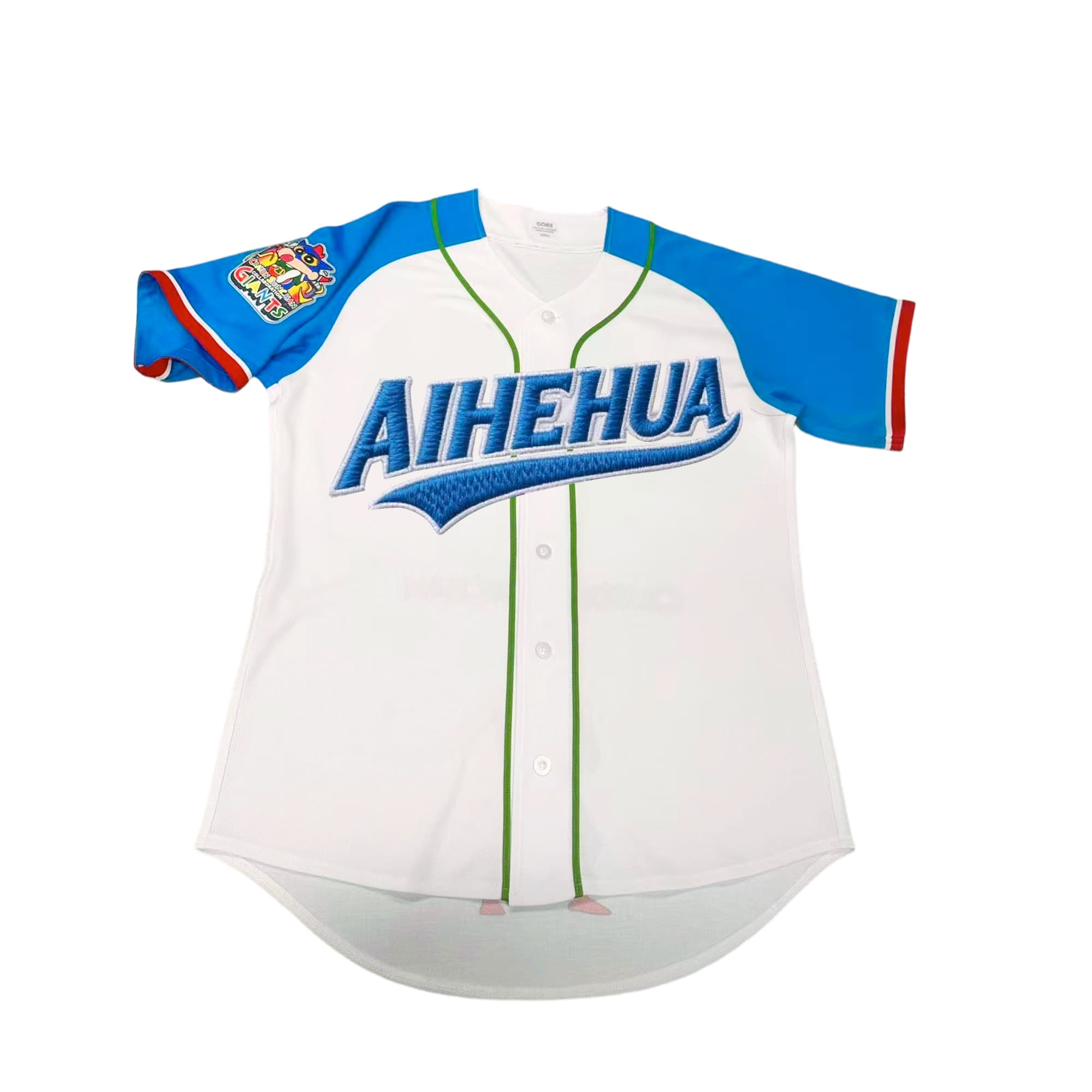
For a white button-front jersey with black piping, sleeve bands, and small contrast panels — the style pattern used in AIHEHUA's custom baseball jersey range — the sample review should confirm piping width and placement, not just the presence of piping. The same applies to a white jersey with blue raglan sleeves and green piping, or a white jersey with black side panels and sleeve blocking. Each style is a placement exercise as much as a color exercise.
Coordinated uniform bags: the overlooked line item
Team orders rarely stop at jerseys. Bags carry uniforms, equipment, and personal gear, and buyers increasingly want them produced alongside the jerseys so colors, branding, and delivery timing stay aligned.
Bringing custom uniform bags into the same order cycle has practical benefits. Branding treatment can be matched across jersey and bag. Delivery can be consolidated. Specification questions get resolved in one sampling conversation instead of two. The trade-off is that bag production introduces its own material and construction variables, so the sampling scope grows.
If bags are part of your plan, raise it at the quotation stage. A supplier that produces both categories can plan the combined order; a jersey-only supplier cannot, and you will end up managing two vendors and two timelines.
What is changing in team uniform sourcing
Several shifts are visible in how B2B buyers approach OEM baseball jerseys. These are qualitative observations about buyer behavior and supplier expectations, not market forecasts.
Buyers want fewer vendors per season
Consolidating jerseys, bags, and related team items with one supplier reduces coordination overhead. The implication for buyers: ask about category breadth early, and confirm that breadth is backed by sampling capability rather than a product list.
Sampling is being treated as a decision gate, not a formality
More buyers are refusing to approve bulk production without a physical pre-production sample that reflects actual materials and decoration. The implication: build sampling time into your season calendar, and budget for the possibility of a second sample round if the first reveals placement issues.
Mixed-age and mixed-size orders are becoming normal
School, club, and community programs often order across children's and adult sizes in one run. Suppliers that treat size runs as a configuration item — rather than a fixed menu — are better positioned for these orders. The implication: confirm graphic scaling across the full range during sampling.
Artwork discipline is separating good buyers from rushed ones
Suppliers increasingly expect vector artwork and explicit placement instructions. Buyers who supply clean files and clear position notes get faster, more accurate samples. The implication: treat artwork preparation as part of your sourcing timeline.
A practical decision sequence for OEM jersey orders
- Define the specification in writing. Body color, sleeve construction, piping and trim placement, wordmark and crest positions, numbering, size range, material, and decoration process.
- Confirm the supplier's configuration model. Ask which of those items are buyer-configured and how each is confirmed.
- Request a pre-production sample. Insist on actual materials and decoration, not a digital rendering.
- Inspect against the checklist above. Compare piping width, trim placement, and graphic positions to your artwork.
- Approve in writing. Reference the approved sample explicitly in your bulk production authorization.
- Plan bags in the same cycle if they are part of the order, so branding and delivery stay coordinated.
The sequence is simple. The discipline is in not skipping steps when a season deadline is close. Buyers who compress sampling to save a week often spend more time resolving placement errors after delivery.