
How to Plan Custom Baseball Jerseys for a Team Order
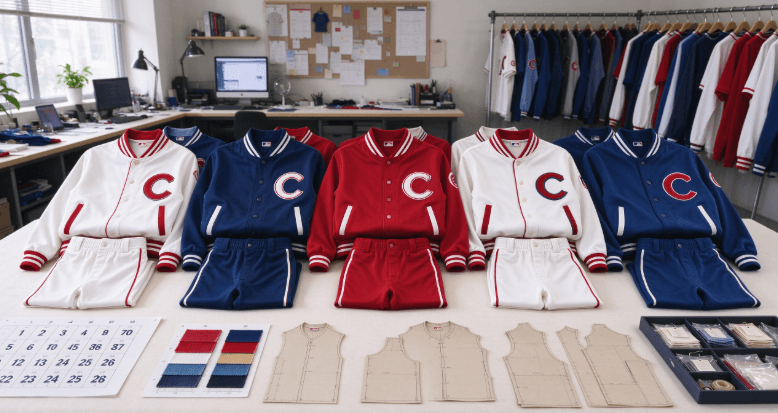
A successful custom baseball jersey order is planned around a complete specification and an approved sample. Team colors, names, numbers, fit, fabric, decoration, and size distribution all need to be settled before bulk production. Aihehua’s website presents custom baseball jerseys and matching uniform bags, and describes OEM/ODM customization, sample approval, and production in Qingdao. It reports a 100-piece minimum order, a 10–15 day sample lead time, and typical bulk production of about one month after sample approval. These are useful planning figures from the company website, not a delivery guarantee; confirm them against the actual design, quantity, season, and shipping route.
Write a design brief that can be manufactured
Begin with the team’s identity and use case. State whether the jersey is for youth, adult recreational play, school, club, tournament, or fan merchandise. Include the preferred silhouette, closure, sleeve treatment, collar, hem, and any layering expectations. Aihehua’s product pages show button-front styles and the company says it can customize colors, size ranges, artwork, and decoration. Use a front, back, and side view to show placement, not only a logo file or a photograph of another garment.
Prepare vector artwork for logos where available and specify each element’s location, width, colors, and orientation. List player names and numbers in a spreadsheet with one row per garment. Identify font style, number height, name position, outline colors, and whether a captain mark or sponsor logo is required. A signed artwork proof prevents late interpretation differences. Confirm that the customer has rights to use team logos and other marks before production begins.
Choose material by performance need, not a vague label
A product page may show the style without identifying a complete fiber composition or fabric weight. Ask the supplier to specify the proposed fiber content, knit or weave construction, fabric weight, stretch behavior, opacity, hand feel, and care characteristics for the exact order. Do not assume that every custom jersey uses the same polyester blend or moisture-management finish. A buyer who has a required specification should put it in writing and verify it on the approved sample or supporting documentation.
A standard test can support a defined performance claim, but the method and acceptance level must be agreed. For example, AATCC lists TM61 for accelerated colorfastness to laundering, TM8 for colorfastness to crocking, and TM135 for dimensional changes of fabrics after home laundering. These methods do not guarantee a particular result by themselves. State what result is acceptable and whether the test applies to fabric, decoration, or the finished jersey.
Build size information from actual measurements
Teams often combine a wide size range in one order. Do not rely on labels such as youth medium or adult large alone, because sizing varies by supplier and silhouette. Request a garment measurement chart and define how chest width, body length, sleeve length, and other relevant points are taken. Compare the chart with a jersey that fits the intended wearer, then order a sample in a representative size. For youth teams, the buyer should confirm guardian-approved size data and avoid using age as the only sizing input.
Create a size-run file with SKU or style, size, quantity, name, number, and any player-specific option. Total the quantities and check that the line items match the purchase order. Keep the approved measurement chart with the final artwork proof. If a tolerance is needed, state it in the order documents and agree how measurement variation will be assessed. The supplier’s production team should not have to infer whether the order requires a relaxed fit, a close fit, or extra room over protective layers.
Plan sampling and schedule around approval
Aihehua’s website reports a 100-piece minimum order and a 10–15 day sample lead time. It also describes bulk production as typically around one month after sample approval. These benchmarks can support an initial schedule, but the buyer should confirm whether the clock starts after deposit, finalized artwork, size-run approval, material confirmation, or another milestone. Shipping, customs clearance, holidays, and third-party inspection add time beyond factory production.
Use a written sample checklist. Confirm fabric hand and color, construction, collar and sleeve shape, stitching, logo scale, number placement, name spelling, and label content. If the sample changes during review, issue a marked revision and obtain a replacement approval when the change affects fit, appearance, or performance. Do not rely on an unrecorded message saying ‘looks fine’; approval should identify the sample version and any accepted deviations.
The table below summarizes the website-published planning information. Confirm these figures in a dated quotation before placing an order.
Aihehua website-published order planning figures
Planning item | Published figure | Buyer action |
Minimum order quantity | 100 pieces per order | Confirm whether styles, colors, or sizes can be mixed |
Sample lead time | 10–15 days | Confirm sample scope, freight, and approval steps |
Typical bulk lead time | About one month after sample approval | Confirm calendar, order size, and shipping separately |
Reported production setup | Two customized lines; about 1,000 pieces/day | Treat as company-reported capacity, not reserved order output |
Confirm decoration and care details
Aihehua’s manufacturing page describes pattern and cutting, sewing, finishing and decoration, including embroidery and heat-transfer numbering. Decide which method applies to each artwork element. Embroidery can suit certain logos but may affect hand and flexibility; heat transfer can support names and numbers but should be tested for adhesion, appearance, and care. The right choice depends on artwork detail, fabric, quantity, budget, and the desired look. Ask the supplier to record the process for each location on the approved tech pack.
Define care instructions based on the actual garment and decoration, not generic advice. For garments sold in the United States, the FTC Care Labeling Rule addresses care instructions for covered textile apparel, and the Textile Fiber Products Identification Act/Rule covers fiber-content identification and related labeling requirements. Other destinations may have different rules. Have the importer or responsible seller confirm market-specific obligations, including fiber content, country of origin, responsible business identity, and care information where required.
Use a clear purchase-order checklist
Before releasing the order, check that the purchase documents contain the approved artwork, size chart, color references, material specification, decoration map, label copy, quantity by size, names and numbers, packaging instructions, and delivery address. Identify who pays for samples, artwork revisions, and shipping. List inspection requirements and the remedy process for shortages, incorrect customization, or defects.
Frequently asked questions
What should a team send for a custom jersey quotation?
Send artwork, style references, fabric requirements, a size breakdown, names and numbers, quantity, delivery date, destination, and packaging preferences.
What do the website’s sample and bulk timelines mean?
Aihehua reports 10–15 days for samples and around one month for bulk production after sample approval. Confirm start points and shipping time in the quotation.
Can one sample approve every team size?
A sample validates its own size and design details. Review the size chart and agreed tolerances for the full size range.