
Custom Uniform Bags for Baseball Teams: A Buyer's Guide
A practical guide to sourcing custom uniform bags for baseball teams: bag types, sizing, decoration, coordination with jerseys, sampling, and supplier verification.
What custom uniform bags are and when a team order needs them
A custom uniform bag is a bag produced for a specific team, club, school, or distributor order, with its size, layout, color, and decoration configured to that buyer's brief. In baseball, the term usually covers two different products: a player uniform bag that carries the jersey, pants, belt, socks, and cap, and a team equipment bag that carries helmets, catcher's gear, baseballs, and shared gear. Buyers often order both in one program so the team looks consistent from the locker room to the field.
Uniform bags make sense when a team order already includes decorated apparel. If you are ordering custom baseball jerseys and team baseball uniforms, adding bags lets you reuse the same artwork, color references, and roster data. The bag becomes part of the kit rather than an afterthought. It also gives distributors a single order to manage instead of a separate bag supplier with a different color standard.
The trade-off is coordination cost. Bags have their own sizing, material, and decoration constraints, and a color that works on jersey fabric may not match on bag fabric. The rest of this guide explains how to plan, specify, and verify a bag program so those constraints are caught before bulk production.
Bag types and what each one is for
Most team bag programs use one or more of the following formats. The right mix depends on how the bags will travel, who carries them, and whether they double as a recruiting or sponsor item.
| Bag type | Typical use | What to specify | Main trade-off |
|---|---|---|---|
| Drawstring uniform bag | Player kit bag for jersey, pants, socks, cap | Flat dimensions, fabric weight, drawstring type, one- or two-sided print | Low cost and light, but limited structure and weather protection |
| Duffel or barrel bag | Player or coach travel bag | Volume in liters, compartment layout, strap and handle construction, base panel | More durable and organized, but higher unit cost and heavier empty weight |
| Wheeled equipment bag | Shared team gear: helmets, catcher's gear, baseballs | Internal dimensions, wheel and handle system, ventilation, load rating | Best for heavy gear, but bulky to store and ship |
| Backpack | Player personal gear and school use | Compartments, laptop or shoe sleeve, strap padding, print area | Popular with younger players, but smaller capacity than a duffel |
| Bat pack or bat sleeve | Carrying bats and personal items | Bat capacity, sleeve padding, attachment points | Specialized; not a substitute for a full kit bag |
For a school or youth program, a drawstring bag plus a coach's duffel is often enough. For a club that travels, player duffels plus one or two wheeled equipment bags per team cover most needs. Distributors may want a smaller core range that can be decorated with different team artwork rather than a different bag for every customer.
How to size bags to your roster and gear
Bag sizing should start from what actually goes inside, not from a catalog number. Measure the folded jersey, pants, and cap, then add allowance for a towel, water bottle, and shoes if those travel in the same bag. For equipment bags, measure the largest item, usually a catcher's helmet or a set of leg guards, and add clearance so gear does not have to be forced in.
A practical sizing sequence:
- List the contents for each bag type: player kit, coach kit, shared gear, or bat storage.
- Measure the largest and heaviest items in their normal stored state, not compressed.
- Add clearance for fabric thickness, zipper travel, and ease of packing. Confirm the allowance with your supplier during sampling.
- Check carry method: a loaded bag should be comfortable for the person who carries it, including younger players.
- Confirm dimensions on the pre-production sample before bulk production.
Roster data matters as much as dimensions. If your team order includes children and adult sizes, as with the jersey programs described in the supplied product evidence, plan bag sizes to match. A single adult-size duffel can overwhelm a youth player, while a small drawstring bag may not hold adult pants and a cap comfortably. Ask the supplier to map bag sizes to your size run and confirm the mapping on the sample.
Coordinating bags with custom baseball jerseys and team uniforms
The strongest uniform bag programs share a visual system with the jerseys: the same team colors, the same wordmark or crest, and a consistent placement logic. That does not mean copying the jersey decoration onto the bag. Bags are usually decorated by printing or embroidery on a flat panel, while jerseys may use twill, tackle twill, sublimation, or screen print. Each process has its own color behavior.
Use these coordination rules:
- Set one color reference for the program. Give the supplier physical color references or approved swatches for jersey and bag materials, and ask them to confirm how each material takes the color.
- Define logo hierarchy. Decide which mark goes on the front panel, which goes on the end or back, and whether player names or numbers appear on bags. Numbering on bags is a common request, but it adds personalization steps and should be confirmed on the sample.
- Keep artwork production-ready. Supply vector artwork with clear color callouts and minimum line weights for embroidery. Thin lines that work in print may not embroider cleanly.
- Plan the size run together. If jerseys are ordered in children and adult sizes, confirm bag sizes in the same planning session so the roster and the bag order stay aligned.
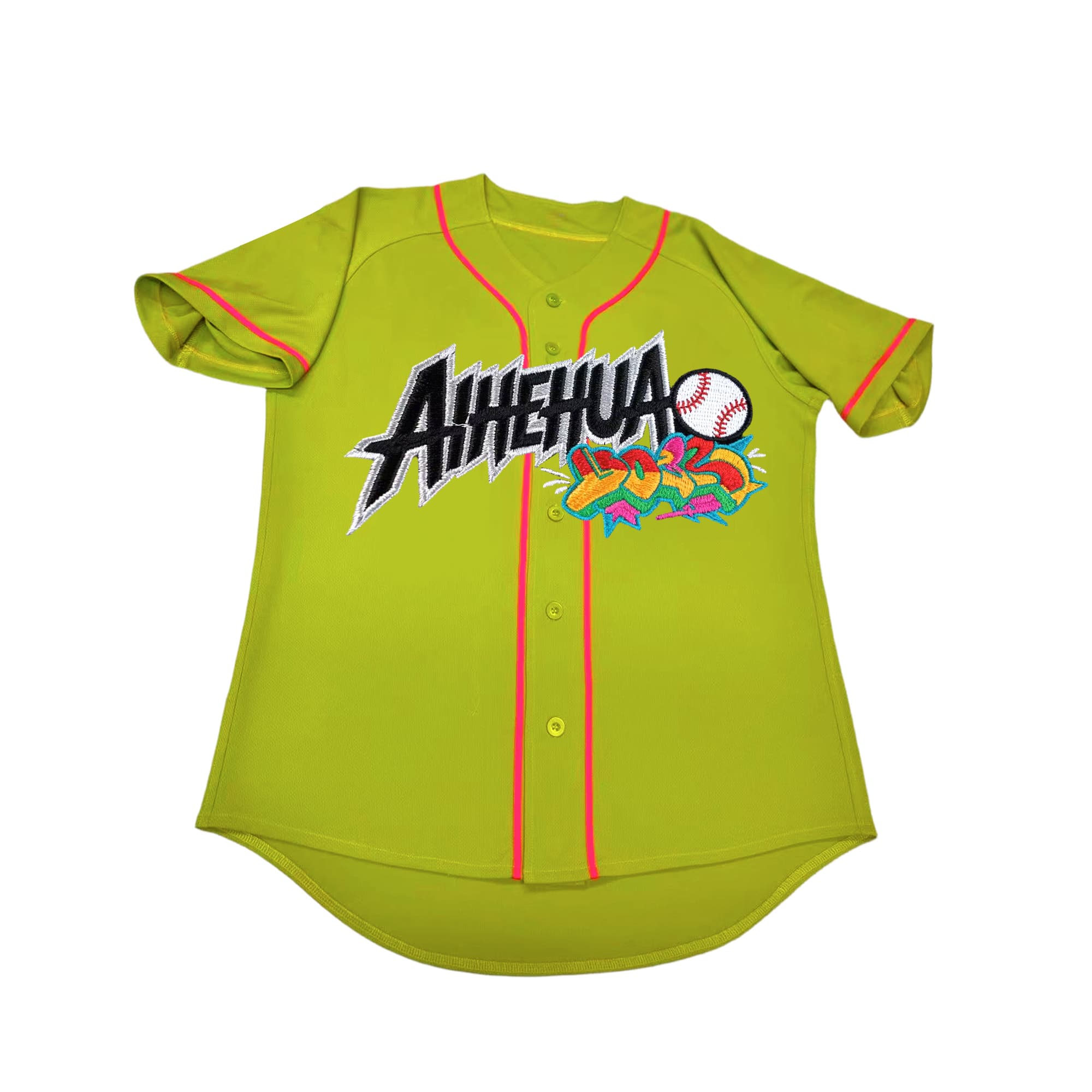
For OEM baseball jerseys, the buyer often supplies artwork and specifications, and the supplier produces to that brief. The same logic applies to bags: the buyer defines the layout, colors, and decoration, and the supplier confirms feasibility through sampling. The supplied product evidence for AIHEHUA's jersey range notes that body, sleeve, piping, and trim placement are confirmed from buyer artwork and the approved sample, and that wordmarks, crests, and numbering positions are confirmed per supplied artwork. That sample-first approach is the right model for bags as well.
Decoration methods for uniform bags and how to choose
Decoration choice affects durability, cost, minimum order behavior, and how closely the bag matches the jersey. The table below compares the common methods at a planning level. Exact suitability depends on bag material and artwork, so confirm with your supplier.
| Method | Best for | Strengths | Limitations to check |
|---|---|---|---|
| Screen print | Large, simple graphics on flat panels | Bold color and good coverage on suitable fabrics | Color count and fine detail limits; ink behavior varies by material |
| Heat transfer | Multi-color logos and small runs | Detailed artwork and gradients | Durability depends on material and application; test on the actual bag fabric |
| Embroidery | Crests, wordmarks, and premium bags | Durable, textured, professional look | Fine detail and small text need adjustment; stitch count affects cost |
| Woven label or patch | Small logos and brand tabs | Consistent appearance across materials | Adds a separate component to specify and inspect |
| Sublimation | All-over patterns on compatible synthetic fabrics | No added ink weight; complex graphics possible | Limited to suitable materials; color can shift on textured surfaces |
Ask for a decoration test on the actual bag material, not a generic swatch. A logo that looks correct on a paper proof can still fail on a dark nylon bag or a textured polyester. The pre-production sample is the place to catch this.
Sampling and approval: what to check before bulk production
The pre-production sample is the control point for the whole bag order. Approve it against a written checklist so that bulk production has a clear reference. A useful checklist covers:
- Dimensions: measure the sample against the agreed specification, including tolerance.
- Materials: confirm fabric, lining, webbing, zippers, and hardware against the approved specification.
- Construction: check stitching, bar tacks at stress points, seam alignment, and handle attachment.
- Decoration: verify logo size, placement, colors, and method against the approved artwork.
- Function: load the bag with representative gear and test zippers, straps, and wheels where applicable.
- Labels and packaging: confirm care labels, size or player labels, and how bags are packed for shipment.
Record any changes and get a revised sample if the changes affect fit, function, or appearance. A signed or written approval on the final sample protects both buyer and supplier. The jersey evidence supplied for AIHEHUA describes confirmation of material and decoration processes during sampling before bulk production; apply the same discipline to bags.
Supplier verification questions for bag and jersey programs
If you are sourcing bags alongside jerseys, verify that the supplier can actually coordinate the two product categories. The questions below are designed to surface gaps before you commit.
- Can you produce both the jerseys and the bags, or coordinate them through one production plan?
- How do you confirm color matching between jersey fabric and bag material?
- What is your pre-production sample process, and what does the buyer approve?
- How do you handle player names and numbers on bags, and what artwork format do you need?
- Can you plan children and adult sizes within the same order?
- What are your inspection points between sample approval and shipment?
- How are bags packed and labeled for team or player distribution?
Be cautious with any supplier that treats bag decoration as a generic add-on without testing on the actual material, or that cannot show how sample approval connects to bulk production. The existing guidance on quality control for custom baseball jerseys from sample to shipment sets out a sample-to-shipment control logic that applies equally to bags.
Cost, lead time, and order planning trade-offs
Bag costs are driven by material, construction complexity, hardware, decoration method, and personalization. A drawstring bag with a one-color print sits at a very different cost level from a wheeled equipment bag with embroidery and player names. Rather than quoting a single unit price, ask for a breakdown by bag type and decoration so you can see where the money goes.
Lead time planning should account for sample rounds, artwork approval, material availability, and decoration. Personalization such as player names and numbers adds a step that depends on receiving a final roster. If your roster is not final, consider ordering bags with team-level decoration first and adding personalization in a later run, or confirm how the supplier handles roster changes before production starts.
Three practical trade-offs to decide early:
- Standard vs. custom construction. A standard bag shape with custom decoration is faster and usually cheaper; a fully custom shape needs more sampling and tooling review.
- One bag for all vs. sized bags. A single size simplifies ordering but fits the roster less well; sized bags improve fit but add planning work.
- Decoration coverage vs. durability. Large printed areas can look strong but may show wear differently from small embroidered marks. Test on the actual material.
Common mistakes in custom uniform bag orders
Most problems in bag programs come from unclear specifications rather than production failure. Watch for these patterns:
- Approving a generic sample. A sample made from different material or with different decoration does not prove the bulk order.
- Ignoring color shift across materials. Jersey and bag colors can diverge even when the same reference is used.
- Leaving personalization to the last minute. Player names and numbers depend on a final roster and add production steps.
- Overlooking carry comfort. A bag that is fine empty can be uncomfortable when loaded with gear.
- No written approval record. Verbal approval creates disputes if bulk production differs from the sample.
Each of these is preventable with a written specification, a tested sample, and a clear approval step.